
Romeoville Epoxy Flooring provides warehouse floor coating in Romeoville, IL, serving surrounding cities including Lemont, Shorewood, Burr Ridge, Mokena and Warrenville. For more than 20 years we have ground, repaired and coated concrete, and warehouse floors are where all of that experience is tested at scale, across slabs measured in acres and schedules measured in shifts.
Romeoville’s tax base leans heavily on industrial and logistics property, and the distribution parks along I-55 and Weber Road hold some of the largest floors in Will County. Those slabs carry forklifts, pallet jacks, order pickers and constant foot traffic around the clock. When joints chip, surfaces dust or markings wear away, productivity and safety suffer.
We work with facility managers to choose the right treatment for each part of the building, from densified and polished concrete in open storage to coatings at charging stations and maintenance areas. Every scope includes slab review and moisture testing, and every schedule is built around keeping the docks running.
Warehouse Floor Problems We Fix
Dusting Concrete
Bare concrete gradually wears under traffic and sheds fine dust that settles on inventory, racking and equipment. That dust gets into machinery, onto products and into the air, and sweeping only stirs it up again.
A lithium silicate densifier hardens the surface and stops dusting, and polishing or coating the slab adds further protection. Both options leave a floor that is easier to keep clean and brighter under warehouse lighting.
Chipped and Spalled Joints
Joints are the weak point in any warehouse floor. Hard forklift wheels strike the edges every time they cross, and once a joint starts to chip, the damage spreads quickly and jolts equipment and loads.
We clean out damaged joints, rebuild the edges with repair mortar and fill them flush with a semi-rigid polyurea joint filler. The filler supports the edges against wheel impact while still allowing the slab to move slightly with temperature.
Worn Markings and Faded Striping
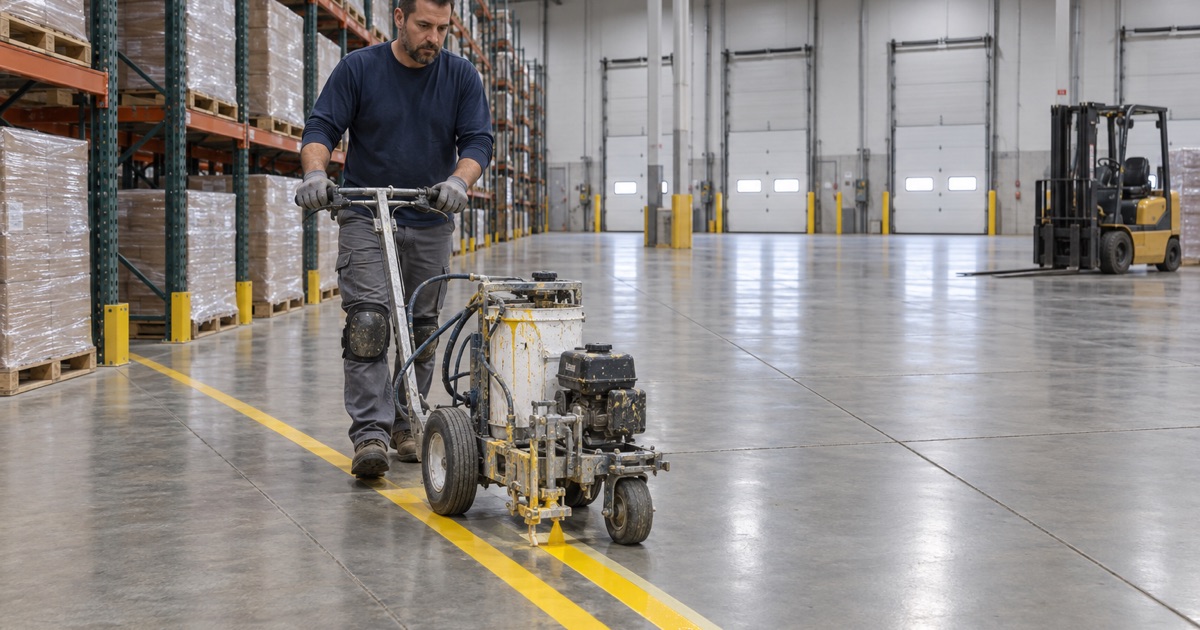
Painted lines on bare concrete wear away quickly under forklift tires, leaving aisles and pedestrian walkways poorly marked. We build markings into coating systems or apply durable striping over densified concrete so they stay visible far longer.
We lay out the striping plan with your safety team before work starts, covering forklift lanes, pedestrian crossings, staging areas and keep-clear zones in front of exits and electrical panels. Getting the layout right once is far cheaper than repainting it every year.
Coating and Floor Options
Densified and Polished Concrete
For large open storage areas, a ground, densified and polished slab is often the best value. There is no coating to wear through at the turning points, the surface resists abrasion from hard wheels, and the brighter finish improves visibility in the aisles.
Polishing also suits buildings that cannot tolerate long cure times, because the floor is ready for traffic as soon as the final pass is finished. A zone polished overnight can carry forklifts again on the morning shift.
Epoxy Coatings for Defined Areas
Battery charging stations, maintenance shops, packaging lines and shipping offices benefit from a coated floor. A 100% solids epoxy resists oils, battery acid spills and cleaning chemicals, and color coding helps separate work zones from traffic areas.
We finish coated zones with a polyaspartic or polyurea topcoat where abrasion is heavy, and add texture where the floor may get wet near dock doors or wash areas. Snow and rain blown in at the docks make that texture worth having through a Will County winter.
Heavy-Duty Systems for Harsh Zones
Areas exposed to food processing, hot washdown or aggressive chemicals need a stronger system than standard epoxy. Urethane cement handles heat, moisture and chemical exposure and is often specified in food distribution and cold storage support areas.
Cooler and freezer docks bring their own challenges, from condensation at the door line to slabs that stay cold year-round. We choose systems rated for those temperatures and schedule the work for conditions the product can actually cure in.
Planning Around Operations
Phased, After-Hours Work
Warehouses rarely stop. We divide the floor into zones and schedule work overnight, on weekends or during planned shutdowns, coordinating with your team to move inventory and equipment zone by zone.
Grinding dust is collected at the grinder with vacuum extraction, never swept into stored goods or washed toward a floor drain or storm inlet. That keeps the rest of the building clean while work continues next to it.
Working Around Racking
Where racking cannot be moved, we coat or polish the open aisles and finish the rack footprints during later windows. Joints and edges are detailed so the floor stays continuous and level across zones.
Rack anchors and column bases are worked around carefully so their attachment to the slab is not disturbed. Where an anchor is loose or a base plate has cracked the concrete beneath it, we flag it for your facility team before coating over the area.
Moisture Testing and Slab Review
Warehouse slabs are often poured directly on grade and may not have been designed with a coating in mind. We test moisture with ASTM F1869 calcium chloride kits or ASTM F2170 in-situ probes, review cracks and joints across the floor, and identify any existing coatings or sealers before specifying a system.
Where readings are high, a moisture-tolerant primer or a polished finish may be the better choice than a standard coating. We explain the tradeoffs in plain terms and read warranty exclusions aloud, moisture first.
Compliance and Pricing
VOC Limits and Local Registration
Illinois limits VOC content in floor and industrial maintenance coatings, and the rule applies to the applicator as well as the manufacturer. In the Chicago ozone nonattainment area that matters, and we choose compliant products for every warehouse job.
Illinois issues no state license for flooring work, so we confirm each village’s contractor registration, bond and insurance rules before scheduling. In Romeoville, every contractor and subcontractor working in the village must be registered.
Per-Square-Foot Pricing
Warehouse floors are quoted per square foot for the system proposed in each zone, with joint repair, striping and after-hours scheduling listed separately. The proposal names the products, the system build and the finished thickness, so what goes down can be checked against what was quoted.
- 20+ Years on Concrete
- Moisture Tested Before Quoting
- Per-Square-Foot Written Quotes