
Romeoville Epoxy Flooring installs ESD flooring in Romeoville, IL, serving surrounding cities including Lemont, Shorewood, Burr Ridge, Mokena and Warrenville. Our crews bring more than 20 years of concrete preparation and resin coating experience to static-control floors, where getting the details right is the difference between a floor that protects components and one that only looks like it does.
Static electricity builds up as people walk and carts roll across a floor. In most buildings it means nothing more than an occasional spark from a door handle, but in electronics assembly, testing labs and data rooms, a discharge too small to feel can damage or weaken sensitive components. An ESD floor gives that charge a controlled path to ground.
These floors are not simply a coating with a special name. They combine a conductive grounding layer, a resin topcoat formulated to hold a specific resistance range, copper grounding connections and testing after installation. Each of those pieces has to be right for the floor to work.
How ESD Floors Work
Conductive and Static-Dissipative Systems
ESD floors come in two broad types. Conductive floors have lower resistance and drain charge quickly to ground, while static-dissipative floors have higher resistance and drain it more slowly and in a more controlled way. Which one you need depends on the components you handle and the standard your customers or quality system requires.
We review your specification before proposing a system. If you have a target resistance range, the proposal states it, along with how the floor will be tested to show it meets that range.
The Grounding Layer
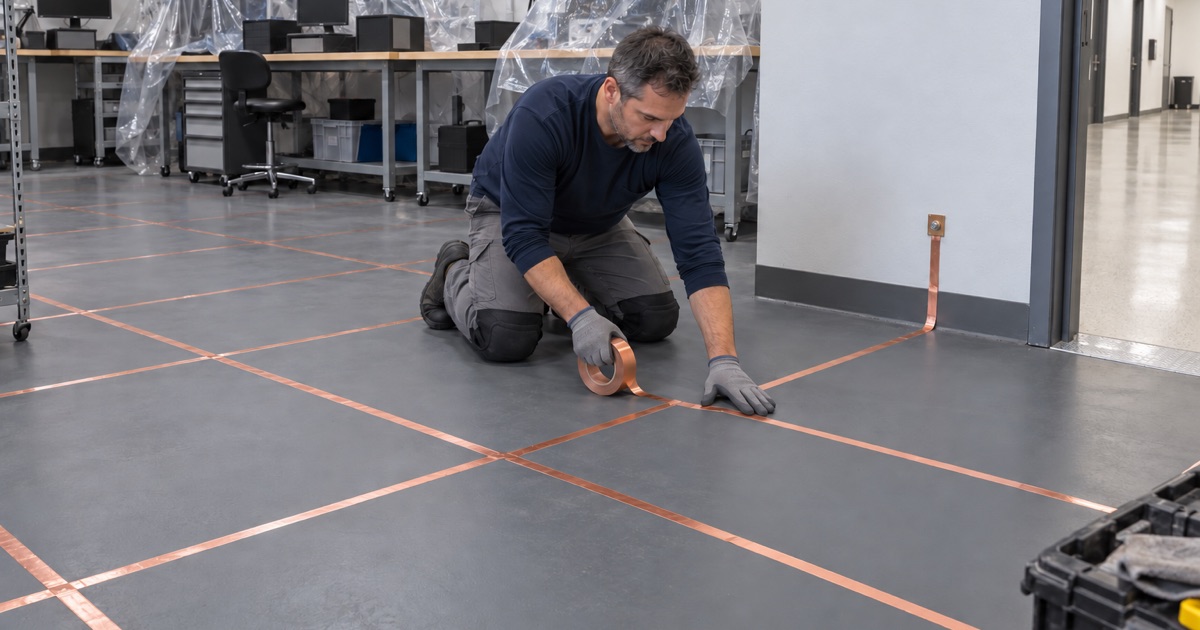
Beneath the visible topcoat, most ESD systems include a conductive primer or a grid of copper tape laid across the slab. That layer collects charge from the surface and carries it to grounding points connected to the building ground.
The grid has to be continuous and properly connected. A gap or a poorly bonded ground point leaves part of the floor isolated, which is why we lay it out carefully and test continuity before the topcoat goes on.
Resin Topcoats With Conductive Fillers
The topcoat is a resin, usually epoxy, loaded with conductive fillers that let charge pass through it to the grounding layer. Its formulation and thickness determine the floor’s final resistance, so both are controlled closely during installation.
These topcoats are available in a range of colors, often light grays and tans that keep work areas bright. Some include visible conductive fibers, which is normal for this kind of system.
Preparing the Slab
Grinding and Repair
An ESD floor needs the same strong bond as any other coating. We diamond grind the slab to remove old coatings, sealers and contamination, then repair cracks and joints so the grounding layer and topcoat can be laid continuously.
We never acid etch. Mechanical preparation gives a consistent profile and leaves no residue that could affect adhesion or electrical performance.
Moisture Testing
Moisture moving up through a slab can affect both adhesion and resistance readings. We test with ASTM F1869 calcium chloride kits or ASTM F2170 in-situ relative humidity probes as part of the scope, and include a moisture-mitigation primer where the readings call for one.
Where ESD Floors Are Used
Electronics Assembly and Repair
Circuit board assembly, electronics repair and component handling areas are the most common users of ESD flooring. The floor works alongside ESD footwear, grounded workstations and wrist straps to keep static away from sensitive parts.
These areas also see carts, chairs and dropped tools, so the floor has to be tough as well as conductive. We choose topcoats that hold their resistance range while resisting abrasion from rolling equipment and the solvents used at workbenches.
Data Rooms and Server Spaces
Data rooms and server spaces use static-control floors to protect equipment during installation and maintenance. Here the floor also needs to be clean, durable and easy to keep dust-free.
A seamless resin floor helps on both counts. With no joints or tile seams to trap debris, the room is easier to keep clean, and the smooth surface sheds far less dust than bare or sealed concrete.
Labs, Clean Areas and Light Manufacturing
Testing labs, cleanroom support areas and some light manufacturing lines need static control alongside chemical resistance and easy cleaning. We match the system to all of those needs, not just the resistance range.
In mixed facilities we often install ESD flooring only in the zones that need it, with a standard epoxy system elsewhere. Clear borders or color changes mark the protected areas so staff know where ESD procedures apply.
Testing, Maintenance and Planning
Testing After Installation
Once the floor has cured, we measure resistance across the surface and from the surface to ground at multiple points. The readings are recorded and provided to you, showing whether the floor meets the specified range.
If any area reads outside the range, we find the cause, whether a grounding connection, a thin spot or residue on the surface, and correct it before handing the floor over. Those first readings also become the baseline for checks later in the floor’s life.
Keeping the Floor Performing
Waxes, polishes and some cleaning products leave films that insulate the surface and push resistance out of range. We recommend cleaners suitable for ESD floors and suggest periodic resistance checks as part of your facility’s maintenance routine.
Scheduling and Pricing
ESD floors are often installed in operating facilities, so we schedule around your production, including overnight and weekend windows, and collect grinding dust at the grinder. Pricing is per square foot for the system proposed, with grounding points, testing and any coating removal listed as separate items.
We also confirm local contractor registration requirements before scheduling, since Illinois issues no state license for flooring or coatings work, and specify products within the Illinois VOC limits for industrial maintenance coatings.
- 20+ Years on Concrete
- Moisture Tested Before Quoting
- Per-Square-Foot Written Quotes