
Romeoville Epoxy Flooring grinds and finishes polished concrete floors in Romeoville, IL, serving surrounding cities including Lemont, Shorewood, Burr Ridge, Mokena and Warrenville. Our crews have been working concrete for more than 20 years, and polishing is the clearest test of that experience, because it puts nothing between the slab and the person looking at it.
A polished floor is made, not applied. We grind the concrete in a series of passes with progressively finer diamond tooling, harden it with a lithium silicate densifier, and keep refining until the surface reflects light. The result is dense, dust-resistant and very hard wearing, with no film to chip, peel or wear through at the tire lines.
Polishing is not the right answer for every slab, so we start by looking at yours. Cracks, old patches and adhesive scars all show once a floor is ground, and we say plainly when a coating will serve a space better than a polish.
How Polished Concrete Is Made
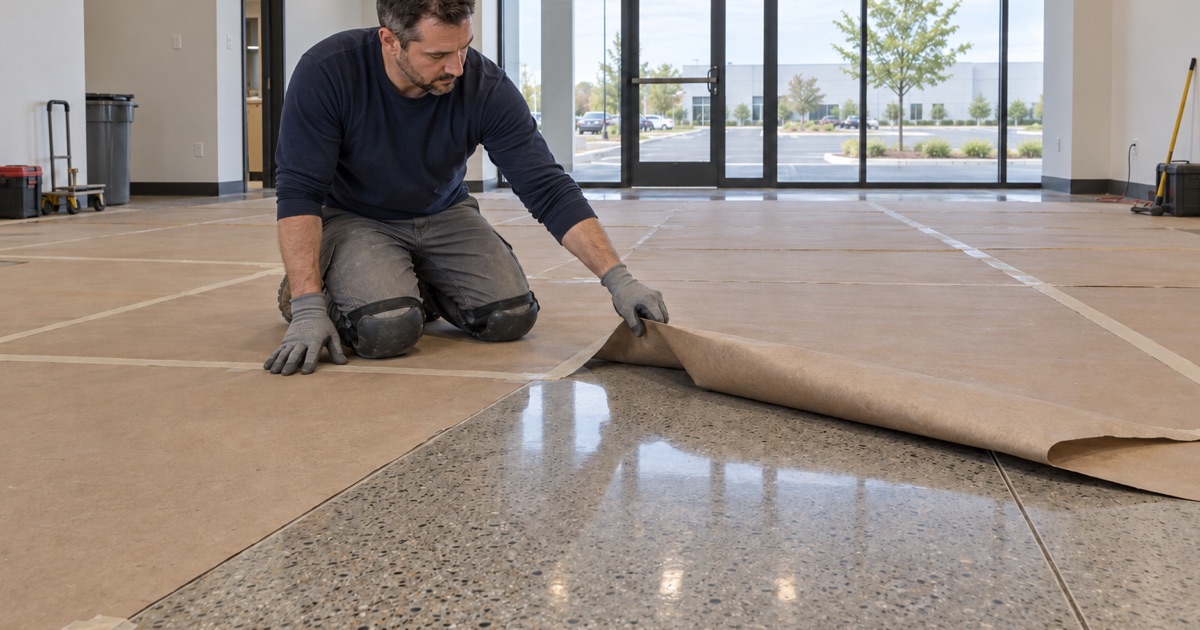
Staged Diamond Grinding
The first passes use coarse diamond tooling to flatten the surface and cut through the weak cream layer. Each pass after that removes the scratch pattern of the one before, so the floor gets steadily smoother until it begins to take a sheen.
The depth of those early passes decides what the floor will look like when it is finished. We agree on the target before we start, because once aggregate has been exposed it cannot be put back.
Lithium Silicate Densifier
Partway through the grinding sequence we apply a lithium silicate densifier. It reacts with the free lime in the concrete to form a harder, denser surface that resists dusting, abrasion and staining.
Densifying is what turns a ground slab into a durable floor. Without it the surface would keep shedding fine dust under traffic, and the polish would wear off quickly in the busiest lanes.
Sheen Levels
Polished concrete can be finished anywhere from a soft satin to a high-gloss reflection. Lower sheens hide scuffs and dust and keep better traction near entries, while higher sheens brighten a room and make it feel larger.
We usually show sample areas on the slab itself, since the same tooling sequence looks different on different concrete. You choose the sheen with your own floor and lighting in front of you.
Aggregate Exposure and Appearance
Cream Finish
A cream finish keeps grinding shallow so very little stone shows. The floor reads smooth and uniform, almost like a solid surface, and it works well in offices and retail spaces where a clean, modern look matters more than texture.
Because the grind stays shallow, a cream finish is also the most sensitive to what the original finisher did. Trowel marks, discoloration and soft spots near old patches can show through, so we check a test area before recommending it for a whole floor.
Salt and Pepper
A salt and pepper finish grinds just deep enough to reveal the fine aggregate near the surface. Small flecks of sand and stone show through evenly, giving the floor some character without the boldness of full exposure.
It is the most forgiving of the three looks on an older slab, since the speckled texture hides minor variation in color and small surface blemishes. Many of the commercial floors we polish end up here, balancing appearance against the time each extra grinding pass adds.
Full Aggregate Exposure
Grinding deeper exposes the larger stones in the mix, producing a terrazzo-like look. It takes more passes and more time, and the result depends entirely on what aggregate was used when the slab was poured, which is why we test an area first.
Some slabs reveal handsome river stone, others mostly gray crushed rock, and a few show an uneven scatter where the mix was poorly placed. Seeing a small exposed patch on your own floor is the only reliable way to know whether full exposure will look the way you hope.
Polished Concrete or a Coating?
When Polishing Is the Better Choice
Polishing suits sound, reasonably flat slabs in dry interior spaces where the goal is durability and low maintenance. With no film on top, there is nothing to peel, scratch through or recoat, and the densified surface simply wears slowly over many years of traffic.
It also suits buildings that cannot tolerate long cure times. Once the final pass is done, the floor is ready for use, which helps when a warehouse or store has a tight window for the work.
When a Coating Serves a Space Better
A coating is the better answer where a floor needs chemical resistance, a specific color, slip texture for wet areas, or a cover for a slab too damaged to look good bare. Garages exposed to winter brine, commercial kitchens and repair bays usually fall here.
We will tell you which way your floor leans after looking at it. Sometimes the answer is a polished floor in the main space and a coated system in the areas that see spills, washdown or salt.
Commercial Polished Concrete Floors
Warehouses and Distribution Floors
Warehouses along the I-55 and Weber Road corridor run forklifts and pallet jacks across huge slabs every day. Polished and densified concrete holds up to that wheel traffic without a coating to wear through, cuts down on dust settling on stored goods, and reflects light so aisles feel brighter.
We work these floors in sections around the building’s operating hours, including overnight and weekend windows, and collect grinding dust at the machine so nothing is swept or washed toward a floor drain.
Retail and Office Spaces
Storefronts and offices choose polished concrete for its clean look and low upkeep. Between leases, old carpet or tile adhesive is ground off along with the surface, giving the next tenant a durable floor in a short turnaround window.
The tile scars and patched trenches left by earlier build-outs need careful filling before polishing, and they may still show faintly afterward. We point those areas out at the walk-through so the owner knows what the finished floor will look like before the work begins.
Showrooms and Light Industrial Spaces
Showrooms and light manufacturing spaces benefit from a floor that looks finished but is still bare concrete underneath. Joints can be filled with a semi-rigid polyurea filler to protect the edges from carts and hard wheels while the polish carries the look.
Residential Polished Concrete Floors
Basements and Lower Levels
A polished basement floor turns a bare slab into a finished surface that will not trap moisture the way carpet can. It is a good fit for dry basements, but we still test moisture first, since a slab with water problems needs those problems solved before any finished floor goes in.
Polishing also removes the need for a coating that could blister if vapor rises later. That said, a polished floor is not waterproofing, and it does nothing to stop water entering through cracks or the wall joint.
Open Living Spaces
Homes built on a slab, or with lower-level living areas, can use polished concrete as the main floor. It pairs well with radiant heat and stays cool in summer, and an area rug is all it takes to soften a room.
Inside an occupied home, dust control matters as much as the finish. Our grinders run with vacuum extraction at the machine, and we plan the work room by room so the rest of the house stays livable while the floor is being polished.
Pricing and Planning
What Moves the Price
We quote polished concrete per square foot for the finish you choose. Deeper aggregate exposure, a higher sheen, crack and joint filling, dye color and the removal of old coatings or adhesive all add time, and each one is listed separately in the proposal.
We do not price from a national average, because two slabs of the same size can take very different amounts of grinding. The quote comes after we have seen the floor, and it reflects the passes your concrete will actually need to reach the agreed finish.
Written Proposals and Contracts
The proposal names the densifier, the sheen level and the exposure class, so you can check the finished floor against what was agreed. Home jobs also get a written contract and the Home Repair: Know Your Consumer Rights pamphlet before work starts, as Illinois law requires.
- 20+ Years on Concrete
- Moisture Tested Before Quoting
- Per-Square-Foot Written Quotes