
Romeoville Epoxy Flooring installs epoxy garage floor systems in Romeoville, IL, serving surrounding cities including Lemont, Shorewood, Burr Ridge, Mokena and Warrenville. With more than 20 years spent preparing and coating concrete, we build garage floors from the slab up, so the finish you see is resting on concrete that has been ground, repaired and tested rather than simply cleaned.
A garage floor works harder than almost any other floor in a house. It carries the weight of cars, takes hot tires straight off the highway, collects oil drips and spends every winter under a film of salt brine. A thin coat of paint cannot handle that, and neither can an epoxy rolled over a dusty or sealed surface.
Our garage systems pair a 100% solids epoxy base with a full vinyl flake broadcast and a polyaspartic topcoat. Before any of it goes down, you get a written proposal naming the products, the layers and the finished thickness, so you can hold the result up against the quote.
What Goes Into a Lasting Epoxy Garage Floor
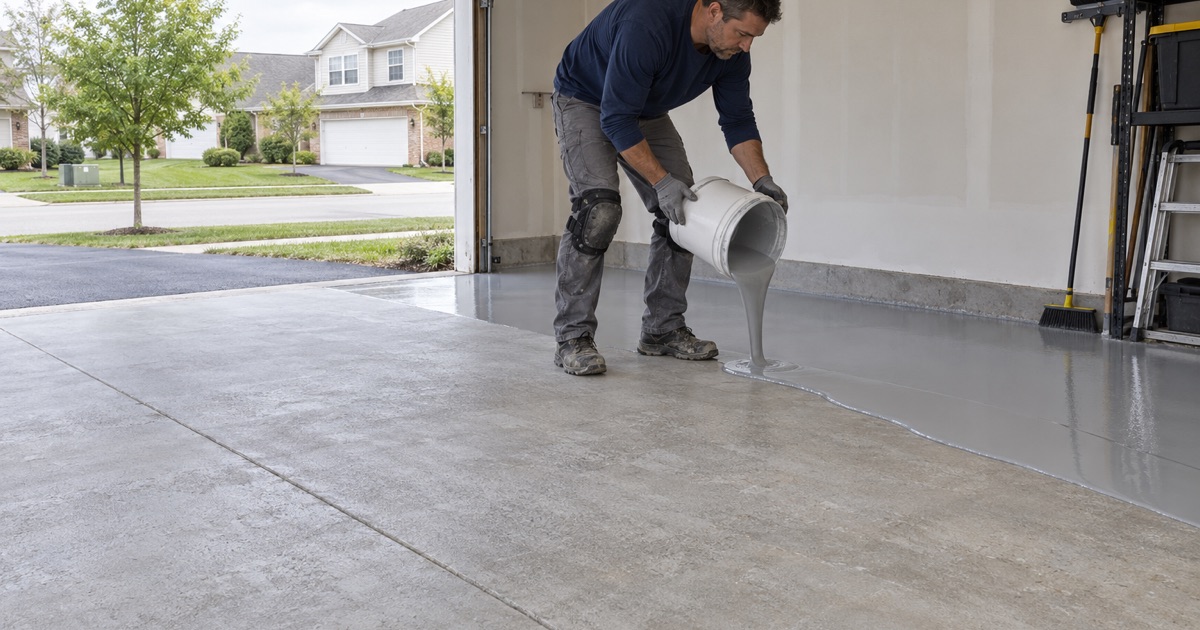
Grinding the Slab Open
Every garage floor we coat is diamond ground first, never acid etched. Grinding removes the weak cream layer on top of the slab, along with old sealers, paint, tire residue and the salt that has worked into the surface. It leaves an open profile on the ICRI scale that the epoxy can bite into.
Acid etching looks easier, but it leaves residue behind, does nothing to remove sealers, and produces an uneven profile. It is the most common reason a kit floor or a cut-price job starts peeling at the tire lines within its first winter. A ground slab gives the coating something solid to hold.
A 100% Solids Epoxy Base and Flake Broadcast
The base coat is a 100% solids epoxy, which means nothing in it evaporates as it cures and the thickness applied is the thickness left behind. Into the wet epoxy we broadcast vinyl flake until the surface is fully covered, then scrape and vacuum the loose chips away.
That full broadcast does two jobs. It builds texture for grip when the floor is wet, and it hides the dust, footprints and salt residue a garage collects between cleanings. Chip size and blend change the look, and we bring physical samples so you can see them in your own light.
The Polyaspartic Topcoat
The final layer is a clear polyaspartic topcoat that locks the flake in place and takes the abuse. Polyaspartic resists abrasion, chemicals and road salt, and it stays clear in the sunlight that comes through an open garage door, where a plain epoxy topcoat would slowly amber.
This is the layer your tires actually touch, so its thickness and cure matter more than any other step. The proposal states how it is built, and the parking date we give you is set by how that topcoat cures at your slab’s actual temperature.
Garage Slabs Around Romeoville
Subdivision Garages From the 1990s and 2000s
Most of Romeoville’s housing went up between 1990 and 2009, as subdivisions spread out after the I-55 and Weber Road interchange opened. Garage slabs from that era have now seen twenty or more winters, and they tend to show surface scaling near the door, worn sealer and pitting along the control joints.
None of that rules out a coating, but it changes the preparation. Scaled areas are ground back to sound concrete and patched, control joints are cleaned out, and spalled edges are rebuilt so the finished floor is flat and continuous.
Hampton Park’s Older Slabs
Hampton Park, built from 1957 on former wetlands along Route 53, holds some of the oldest garage floors in the village. Concrete of that age has often been patched, partly replaced or coated before, and some slabs have settled at the edges or near the apron.
We look at these floors with repair in mind first. When a section has dropped or broken into separate pieces, a new slab built to Romeoville’s own rules, 4 inches thick with 6x6 wire mesh on compacted CA-6 gravel, is the right first step rather than a coating spread over a failing base.
Garages Without a Vapor Barrier
The residential code’s garage vapor retarder exception means many garage floors were poured without a plastic sheet underneath. Moisture can rise through those slabs unseen, then push a nonbreathing coating off from below.
That is why moisture testing is its own line in our garage quotes. Depending on the slab we use an ASTM F1869 calcium chloride test, ASTM F2170 in-situ relative humidity probes or an ASTM D4263 plastic sheet check, and a high reading leads to a moisture-mitigation primer or an honest no.
Winter Salt, Hot Tires and Cure Timing
Calcium Chloride Brine and Rock Salt
Will County roads are treated with rock salt and calcium chloride brine, and every car brings some of it home. On bare concrete the brine soaks in and recrystallizes as it dries, which slowly breaks up the surface and leaves white rings around the tire lines.
A properly bonded flake system with a polyaspartic topcoat keeps that brine sitting on the surface instead of soaking in. It can then be squeegeed out the door or mopped up, and the concrete underneath stays protected through the season.
Stopping Hot Tire Pickup
Hot tire pickup happens when tires warmed by highway driving soften a thin coating, then pull it up as they cool and grip. It shows up as peeled patches exactly where the car parks, and it is the classic failure of thin store-bought kits.
The cure is a ground slab, a full-thickness 100% solids base and a hard polyaspartic topcoat. Built that way, the coating is bonded too well and is too thick to lift, even under a car pulled in straight off I-55 on a summer afternoon.
When an Unheated Garage Has to Wait
Epoxy needs warmth to cure, and topcoats are sensitive to moisture condensing when the slab sits close to the dew point. We schedule installs against measured slab temperature and the dew point spread at the surface, not against a date on the calendar.
A heated, attached garage can often be done in winter. An unheated detached garage in January usually cannot, and we will tell you to wait for spring rather than install a floor that cures soft, turns cloudy or loses its bond at the first thaw.
Our Step-by-Step Epoxy Garage Floor Process
Step 1: Slab Walk and Moisture Test
We start by walking the floor with you, marking cracks, old coatings, oil-soaked areas and drainage toward the door. Moisture testing happens here, before a price is set, so the proposal reflects the slab you actually have.
Step 2: Grinding and Repair
The floor is diamond ground edge to edge, with dust collected at the grinder rather than swept or washed toward a floor drain. Cracks, spalls and pitted joints are then filled and ground flush so the surface is ready to coat.
Step 3: Base Coat and Flake
The 100% solids epoxy base goes down and is fully broadcast with your chosen flake blend while it is still wet. Once it has cured, the excess chips are scraped and vacuumed off to leave a uniform texture.
Step 4: Topcoat and Cure
The polyaspartic topcoat is rolled over the flake to seal it in and build the wearing surface. We then give you a walk-on time and a parking date based on the actual cure conditions in your garage.
Pricing, Paperwork and Warranty
Priced by the Square Foot for Your Floor
We quote garage floors per square foot for the exact system proposed, rather than from a national price for a two-car garage. Old coating removal, crack repair, a moisture-mitigation primer and your choice of flake and topcoat are listed as separate lines so you can see what moves the number.
Written Contract and Consumer Rights Pamphlet
Every home garage job gets a written contract and a copy of the state’s Home Repair: Know Your Consumer Rights pamphlet before work begins, as the Illinois Home Repair and Remodeling Act requires. The contract names the products and thickness from the proposal, so nothing changes quietly between quote and install.
Warranty Exclusions, Moisture First
Garage coating warranties nearly always exclude damage caused by moisture or hydrostatic pressure from below the slab. We read the exclusions to you before you sign, starting with moisture, so you know exactly what is covered and why the testing step matters.
- 20+ Years on Concrete
- Moisture Tested Before Quoting
- Per-Square-Foot Written Quotes